
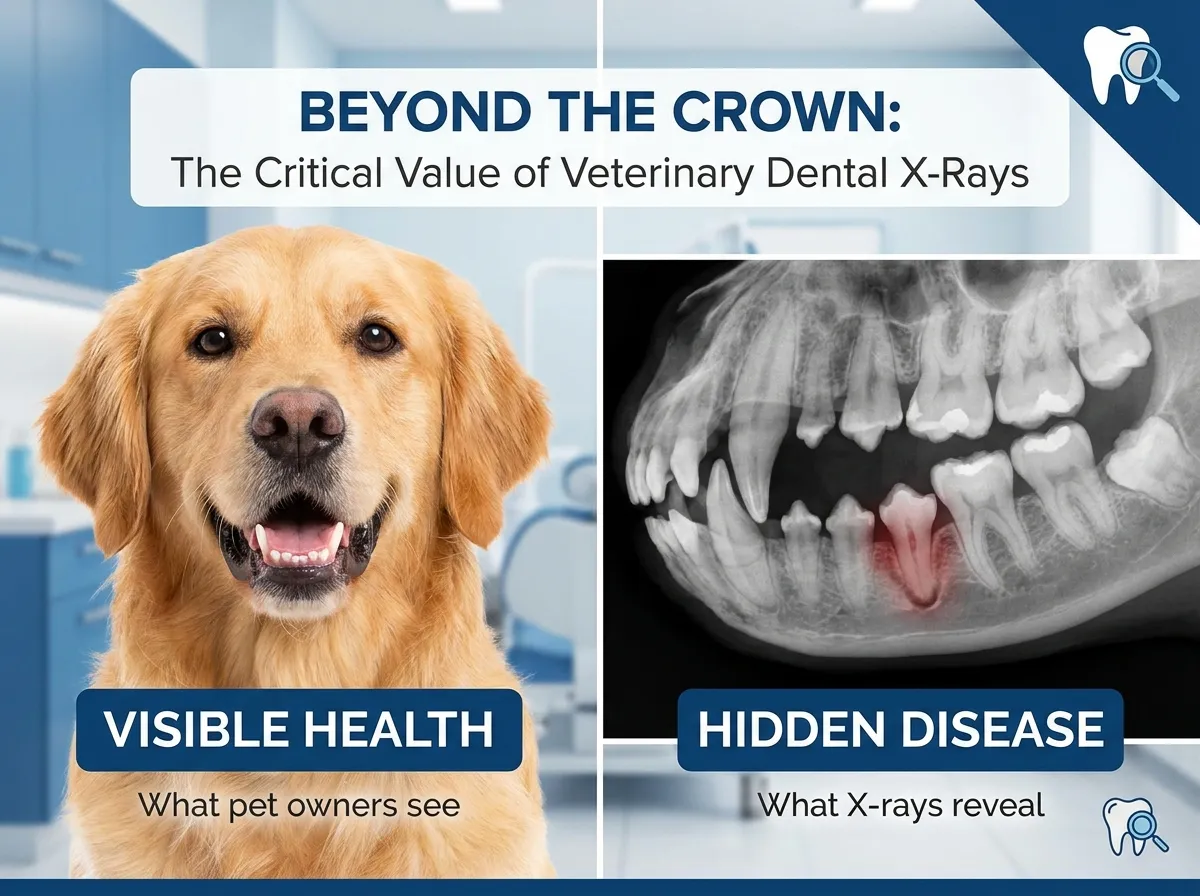
To a pet owner, dental X-rays can feel like an unnecessary add-on. They see their dog or cat eating fine and assume that since the crowns look relatively clean, there's no need for internal screening. They don't understand that dental disease hides beneath the surface.
1. The Iceberg Analogy: Visualizing Hidden Disease
The most effective way to explain dental radiography is the “iceberg analogy.” Explain that the crown is just the tip of the iceberg, and the roots, jawbone, and periodontal space are where real dental diseases hide. Use simple graphics on your website to visualize this.
Without radiographs, your clinic is only diagnosing what can be seen visually. Explain to clients that scaling and polishing a tooth with diseased roots is like painting a rotten fence post. It looks nice on the outside, but it is structurally compromised and continues to cause pain.
2. Share Real Radiography Case Studies
Showcase anonymized cases where a pet had normal-looking teeth but X-rays revealed severe pathology (such as painful resorption or root abscesses). Sharing these clinical discoveries build deep credibility and trust with pet owners. It demonstrates that X-rays find pain that is otherwise invisible.
Create short case study summaries. Include a photo of the crown (which looks clean) and the corresponding x-ray (which shows severe root bone loss). Detail the treatment performed and the positive changes the owner observed in their pet's energy levels afterward.
- Use Handouts: Give owners a simple laminated chart showing healthy tooth roots versus diseased, resorbing roots. Visual comparisons drive message clarity.
- Standardize Language: Shift from “Would you like X-rays?” to “We perform dental radiographs to examine the 60% of the tooth structure hidden under the gums, which is our medical standard.”
- Embed X-Rays in Discharge: Print or email the digital dental radiographs along with the discharge notes so they see the diagnostic proof.
- Explain Bone Loss: Help clients understand that bone loss around roots leads to loose teeth, jaw fracture risks, and chronic discomfort.
3. Make Radiography Part of the Base Cleaning Package
Avoid making dental X-rays an optional charge. Standardizing radiography into your base dental price ensures high medical standards and eliminates client hesitation over individual diagnostic lines. It protects your clinic's medical standards and guarantees a complete diagnostic path.
When X-rays are optional, clients feel pressured to make a medical decision they aren't qualified to make. By packaging them together, you simplify the invoice and establish radiography as a baseline medical requirement.
4. Educate via Social Media and Email
Post real, interesting x-ray findings on social media. Explain what the image shows in plain English (e.g. “We found a hidden pocket of infection under this tooth that was causing Max to chew only on one side!”). Empathy-led education is the best form of marketing.
Explain terms like “resorption” or “abscess” in clear, non-jargon terms. Create blog posts addressing “frequently asked questions about veterinary dental x-rays.” Proactive education makes clients feel informed and valued.
5. Train Staff on the “Why” of Radiography
Your veterinary receptionists and assistants must be able to explain the importance of X-rays. If a client calls asking, “Why is the cleaning so expensive? Is it because of the X-rays?” your team must have a clear, confident response explaining the diagnostic necessity.
6. Presenting X-Rays on Mobile Devices
Use tablets or screens in the exam room to display x-rays. Show the client the images while their pet is in recovery. When owners see the root structure and the doctor points out the area of interest, they feel confident in the value of the care provided.
VetGuider specializes in building premium educational pages, custom diagrams, and SEO-optimized medical blogs for veterinary practices.
Talk to our experts