
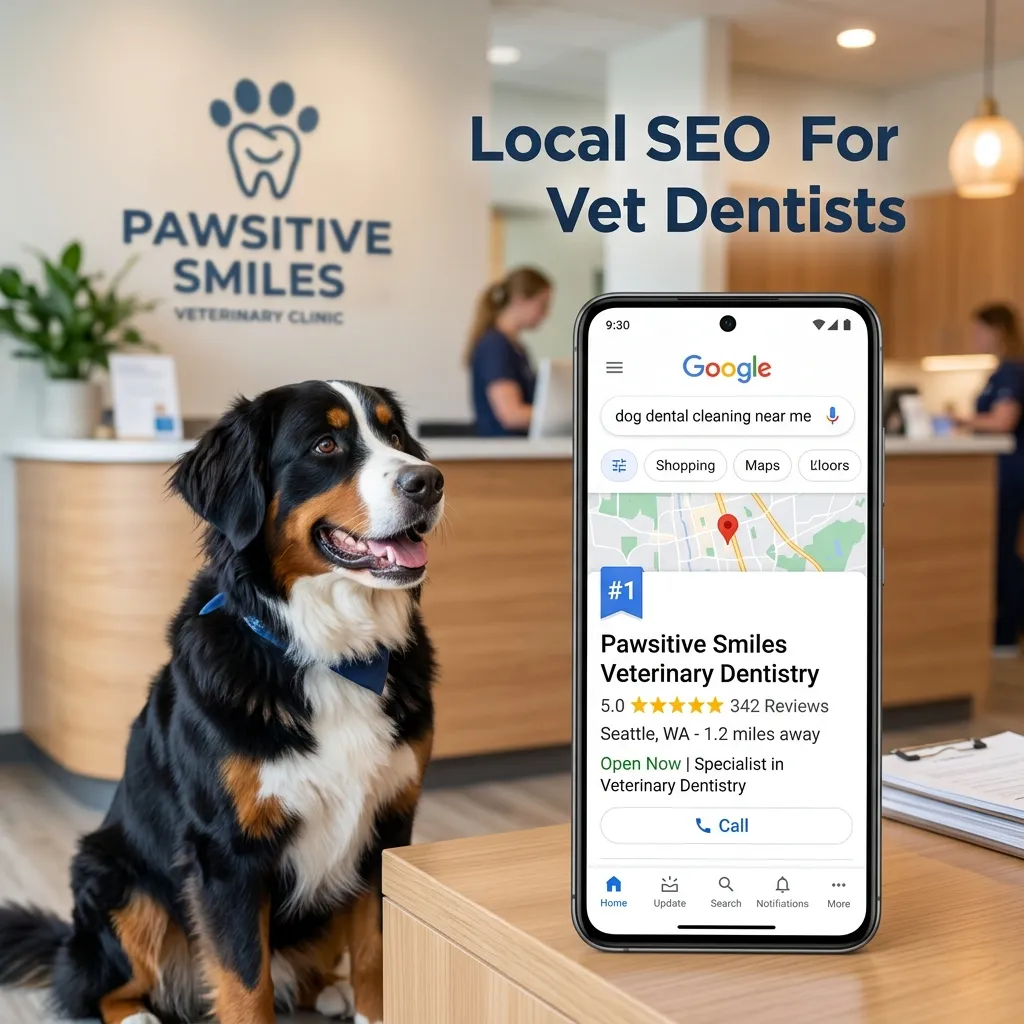
When a pet owner notices their dog has extremely bad breath or seems to be chewing on only one side of their mouth, they don't look for national articles. They open their phone, pull up Google Maps, and type: “dog dental cleaning near me” or “veterinary dentist near me.”
What is Local SEO for Veterinary Clinics?
Local Search Engine Optimization (SEO) focuses on positioning your veterinary clinic in search engine results for localized queries. Because veterinary medicine is inherently local, your digital footprint needs to tell Google exactly where you are located and what clinical specialties you offer, particularly high-margin services like pet dentistry.
1. Optimize Your Google Business Profile (GBP)
Your Google Business Profile (formerly Google My Business) is the foundation of local SEO. If your profile is incomplete or unoptimized, Google will not show your clinic in the Local Map Pack.
First, ensure your primary category is set to “Veterinarian” or “Animal Hospital.” Next, add “Pet Dental Care,” “Dog Dental Cleaning,” and “Feline Dentistry” to your services list. Provide detailed descriptions for each service, highlighting key safety and medical standards (like the use of digital dental X-rays and multi-parameter anesthetic monitoring).
- Services Directory: Explicitly add “Dog Dental Cleaning” and “Cat Teeth Cleaning” with descriptions and starting prices (if applicable).
- Q&A Section: Proactively post and answer common questions, e.g., “Do you offer dog teeth cleaning under anesthesia?”
- Photos and Updates: Regularly upload high-quality, professional photos of your modern dental suite, dental radiographs, and happy pets post-recovery.
2. Drive Reviews that Contain Dental Keywords
Google's ranking algorithm scans the text of customer reviews for matching search terms. When a client reviews your practice and writes, “The team performed a dental cleaning and extraction on my senior dog, and they were wonderful,” that review acts as a major ranking signal for the keyword “dog dental cleaning.”
Develop a system to ask for reviews, specifically targeting dental clients. When sending post-op follow-up emails or texts, guide their feedback. You might ask: “How did your pet do during their dental cleaning with us? Share your experience!” This naturally prompts clients to mention the specific service in their review.
3. Build Geographically Targeted Service Pages
Do not rely on a single, generic “Services” page. Create a dedicated page for your dental services: `/services/pet-dental-cleaning`.
Optimize this page with local headings (e.g., “Professional Dog Teeth Cleaning in [City Name]”). Include schema markup—specifically LocalBusiness and Service schemas—so search engines can index your location coordinates, service definitions, and operating hours in a structured way.
4. Establish Local Citations and Pet Partnerships
A citation is any online mention of your clinic's Name, Address, and Phone Number (NAP). Ensure your NAP data is identical across all directories, including Yelp, Apple Maps, YellowPages, and veterinarian-specific directories.
Additionally, earn local links by partnering with neighborhood businesses. Offer to write educational dental safety flyers for local dog groomers, boarding facilities, or pet boutiques in exchange for a link to your clinic's dental services page on their website.
VetGuider builds local SEO structures, optimizes Google Business Profiles, and designs high-ranking veterinary websites to drive local clients directly to your doors.
Book a Local SEO Audit